Kakeya Conjecture in All Dimensions
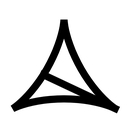
Sōichi Kakeya asked for the smallest area in which a needle of length 1 can turn all the way around. The needle has no thickness. A disk of diameter 1 works, and its area is about 0.785. The deltoid in the figure, a triangle with curved sides, works too, and its area is about 0.393.
The surprising answer came from Abram Besicovitch. No smallest area exists. The needle can turn around in a region of any positive area, however small. It does this with many small turns and long slides.
A related idea drops the motion. A Kakeya set contains a needle pointing in every direction, but the needle does not have to travel between these positions. In the plane, such a set can have area exactly zero.
Here is the idea. Take a triangle and cut it into many thin slivers, each with its point at the top. Slide the slivers sideways so that they overlap. Each sliver keeps the same directions, because sliding does not turn it. But the total area is now smaller. More slivers and more careful overlap make the area as small as you like.
So area cannot tell us how large these sets are. Another measure can, and it is called dimension.
Cover a shape with small boxes, then make the boxes 10 times smaller and count again. A line needs 10 times more boxes. A filled square needs 100 times more, which is . A solid cube needs 1,000 times more, which is . The power of 10 is the dimension: 1, 2 and 3.
The dimension does not need to be a whole number. Start with a line, remove its middle third, then remove the middle third of each piece, and continue forever. This is the Cantor set, and its total length is zero. Each time the boxes get 3 times smaller, you need 2 times more, which gives a dimension of about 0.63. So a shape can have zero length and still have positive dimension.
In dimensions, a point is a list of numbers. The Kakeya conjecture says that every Kakeya set in dimensions has dimension . In the plane, the set can have zero area, but covering it still takes nearly as many small boxes as covering a filled square. So the needles can overlap a lot, but only up to a limit. The exact statement uses a refined count called Hausdorff dimension.
The cases of 2 and 3 dimensions were already known. OpenAI reports a proof for every number of dimensions.
The proof uses waves. A wave can focus and become very large at one instant, as when ripples meet at one point. The local smoothing conjecture limits how long such focus can last. Narrow beams of a wave travel along thin tubes, so a limit on focus gives a limit on how much tubes can overlap. That limit gives the Kakeya statement.